
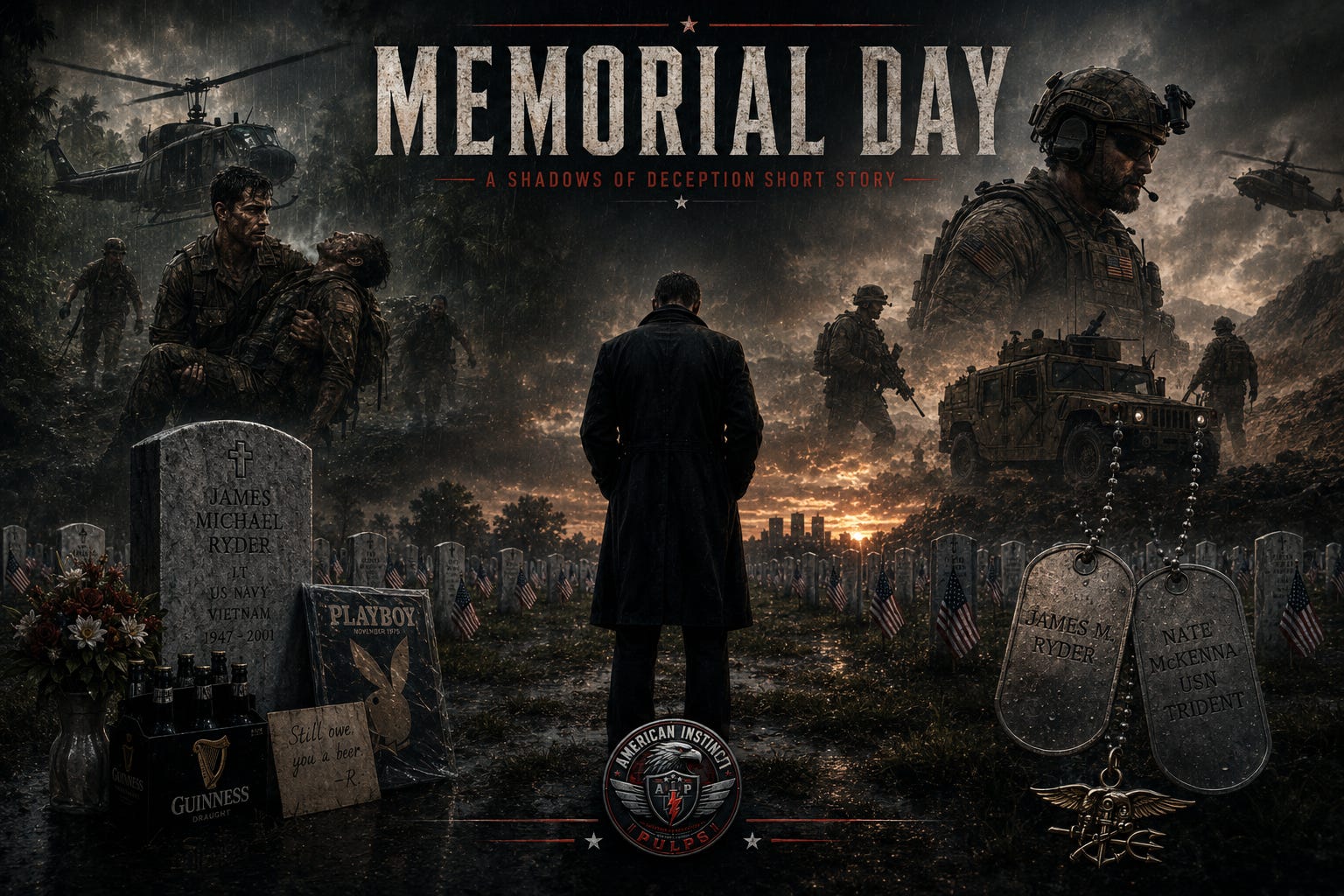
MEMORIAL DAY
A Shadows of Deception Short Story

The song came on just as the sun began bleeding over Tampa Bay.
John Ryder almost changed the station.
His hand moved toward the radio in the dashboard of the black 1967 GTO, fingers hovering over the chrome knob while the first notes of Dire Straits drifted through the speakers. Soft guitar. Distant. Wounded. Like something carried over water from another life.
Brothers in Arms.
John kept his hand there a moment.
Then he let it fall back to the wheel.
The bridge stretched ahead of him beneath a bruised dawn sky, long and empty except for a few early commuters and patrol cars parked along the shoulder. American flags snapped from light poles in the humid wind. Red, white, and blue against the pale gray morning. Memorial Day weekend in Florida. The radio host had been talking between songs about cookouts, beach traffic, and honoring the fallen before the music cut him off.
John preferred the music.
Words were cheap.
The GTO rumbled across the Howard Frankland Bridge, its armored frame disguised beneath polished black paint. Most men saw a restored muscle car. A collector’s dream. They didn’t see the ballistic glass, reinforced panels, hidden compartments, or the weapons system tied into the dash beneath a false panel.
They didn’t see the coffin on wheels.
John wore a charcoal suit, open collar, no tie. His right hand rested loose on the wheel. His left thumb traced the worn edge of a silver watch on his wrist.
James Ryder’s watch.
His father’s.
The song filled the cabin.
These mist covered mountains...
John’s jaw tightened.
He saw Afghanistan.
He saw Karmana.
He saw Mack grinning through dust and blood, yelling over the gunfire that if he died, somebody better delete his browser history.
John blinked hard and kept driving.
At a gas station off the bridge, he pulled in for coffee he didn’t want. He stood near the pump while fuel moved through the hose and watched a pickup truck with Marine Corps stickers pull into the next lane. An old man climbed out slowly, wearing a faded Vietnam veteran cap and a denim jacket despite the heat.
The old man looked at John once, then at the watch.
His eyes narrowed.
“That insignia,” the man said.
John said nothing.
The old man nodded toward the watch. “Haven’t seen that in a long time.”
John slipped his hand into his pocket. “Probably not.”
“You serve?”
“Yeah.”
“Lose people?”
John looked toward the flags across the street. “Yeah.”
The old man’s face softened.
“Memorial Day ain’t about politics, son. It’s about carrying people with you after they’re gone.”
The pump clicked off.
John removed the nozzle and hung it back in place.
“Take care of yourself,” the old man said.
John nodded once.
He got back into the GTO.
The song was still playing.
This time, he turned it up.
In Laos, the rain came down hard enough to erase the world.
Lieutenant James Ryder lay flat in the mud and watched the jungle breathe.
Beside him, Thomas Roberts smoked half a cigarette cupped under his poncho, the ember shielded from the rain by hands that had killed men, saved men, and shaken from nicotine withdrawal more times than either of them would admit.
“You know,” James whispered, “one of these days we’re gonna get sent somewhere dry.”
Roberts looked at him. “You say stupid things when you’re bored.”
“I say hopeful things.”
“You say stupid things hopefully.”
James smiled.
Ahead, through veils of rain and black foliage, the remains of a Green Beret recon team waited somewhere near the Ho Chi Minh Trail. At least that was the official version. Six men missing. Emergency beacon triggered and then silenced. Command wanted the team found fast and quiet.
Fast and quiet usually meant somebody was lying.
Roberts knew it.
James knew it too, though he still had the talent for making other men believe things weren’t as bad as they were.
Behind them, four more operators crouched in the wet dark. Men with painted faces, heavy packs, and the thousand-yard patience of soldiers who had already accepted the jungle might be their grave.
Roberts checked his watch.
“Move in two,” he whispered.
James shifted his CAR-15 against his shoulder. “You ever think about home?”
“No.”
“Liar.”
Roberts exhaled smoke through his nose. “I think about cigarettes. Women. Hot food. Cold beer. In that order.”
“Guinness?”
“If God loves us.”
James grinned. “God loves me. You’re on your own.”
Roberts crushed the cigarette into the mud.
“Move.”
They slipped into the jungle.
Helmand Province smelled like dust, sweat, diesel, and bad decisions.
Petty Officer John Ryder stood through the roof hatch of a Humvee, beard full of grit, Oakleys covering his eyes, one hand wrapped around the mounted gun while AC/DC blasted from somebody’s speaker inside the vehicle.
He was twenty-something, dangerous, and convinced death had poor timing.
His team loved him for it.
His chief did not.
“Ryder,” Chief Alvarez called from inside the Humvee, “sit your ass down before somebody with a rusty AK gets lucky.”
John glanced down. “Relax, Chief. They’d have to aim first.”
Nate “Mack” McKenna laughed from the back seat. “That’s our fearless leader. Too handsome to die, too dumb to duck.”
John grinned. “Mack, if you die today, I’m telling your mother everything.”
Mack pointed at him. “Delete my browser history first. Then tell her I died doing charity work.”
The Humvee bounced hard over a rut. Everyone cursed.
Dust rolled across the convoy as they cut through the desert road toward a village near the Pakistani border. Their target was a Taliban financier with foreign handlers and a habit of moving money through mosques, opium routes, and dead men’s pockets.
The intel was thin.
The brass wanted action anyway.
John liked action.
Back then, action still felt clean.
Mack fished an old iPod from his vest and plugged it into the aux cable.
The music changed.
Hard rock cut off mid-riff, replaced by the slow mournful guitar of Dire Straits.
The younger guys groaned.
“What the hell is this?” one of them said.
Mack laughed. “Old man deployment music.”
Chief Alvarez leaned forward from the passenger seat.
“Nah,” he said. “This one stays.”
No one argued.
The convoy pushed into the mountains as Brothers in Arms played beneath the rattle of weapons, engines, and men pretending they weren’t afraid.
John Ryder smiled into the wind.
He still thought every war could be beaten by men who were good enough at violence.
Thomas Roberts arrived at John’s townhouse just after noon without calling first.
That was how Roberts did things.
John found him standing in the armory behind the house, smoking beneath the open garage door like he owned the place. Roberts had aged into a hard piece of weathered iron. White hair. Pale eyes. A suit that looked expensive and slept in. The cigarette in his hand looked less like a habit than a life-support system.
John entered without a word.
Roberts looked around the armory. Rifles. Pistols. Body armor. Ammo crates. A man could overthrow a small country with what John kept in that building.
“Your father would’ve admired the organization,” Roberts said.
“He would’ve asked why I needed this much.”
“No. He would’ve asked why you didn’t have more.”
John stopped by the workbench. “Why are you here, Tom?”
Roberts reached into his coat and removed a brown envelope.
John’s eyes went to it.
Roberts placed it on the bench but kept two fingers resting on top.
“Files surfaced,” Roberts said. “Old Laos material. May of ’72.”
John stared at him. “My father?”
Roberts nodded. “Among others.”
“What kind of files?”
“The kind that were never supposed to exist.”
John’s face hardened. “Then why show up with them now?”
“Because it’s Memorial Day.”
“That’s not an answer.”
“It’s the only one I’ve got.”
John stepped closer. “You’ve had something from him, haven’t you?”
Roberts did not answer quickly enough.
John’s voice dropped. “How long?”
Roberts removed his fingers from the envelope. “Decades.”
John picked it up. “You son of a bitch.”
“It’s a letter.”
“To who?”
“To you.”
The words hit harder than John expected.
Roberts looked away first.
“He wrote it before an operation. Didn’t know if he’d make it back. Asked me to hold it until the right time.”
“The right time?” John said. “My father has been dead since 2001.”
“I know.”
“You knew I spent half my life trying to understand who he was.”
“I know.”
“And you kept this from me?”
Roberts’s cigarette trembled slightly between his fingers. Not much. Enough.
“Yes.”
John took a step toward him. “Why?”
“Because you weren’t ready.”
John laughed once, cold and sharp. “That’s convenient.”
“No,” Roberts said. “It’s cruel. There’s a difference.”
John gripped the envelope.
Roberts met his eyes.
“Your father wasn’t perfect,” Roberts said. “But he was one of the best men I ever knew.”
John looked down at the letter in his hand.
For a moment, he wanted to tear it open.
For another, he wanted to burn it.
Instead, he set it back on the workbench.
“Get out,” John said.
Roberts nodded like he’d expected nothing else.
He walked toward the door, then paused.
“George Bishop’s having a gathering tomorrow. Veterans. Gold Star families. No cameras. No speeches worth a damn.”
John said nothing.
“You should go.”
“I don’t do gatherings.”
“You do ghosts. Same thing.”
Roberts left him there with the envelope.
John didn’t open it.
Not yet.
In Laos, they found the first body at dawn.
Green Beret. Maybe twenty-five. Tied to a tree with commo wire. Throat cut. Boots missing.
James crouched beside him, rain dripping from his helmet.
Roberts stood behind him, face unreadable.
One of the operators crossed himself.
James carefully cut the dead man loose and lowered him into the mud.
“Name?” Roberts asked.
James checked the man’s tags. “Dalton. Staff Sergeant William Dalton.”
Roberts looked toward the tree line. “The others?”
“Tracks head north.”
“That’s toward the trail.”
“That’s toward whatever killed him.”
Roberts lit a cigarette despite the rain. “We’re not here for revenge.”
James looked up at him. “No. We’re here to bring them home.”
Roberts held his stare.
Then he nodded.
They moved north.
By midday, they found evidence that changed everything.
Soviet ration tins.
Boot prints that weren’t NVA.
A weapons crate stenciled in Cyrillic.
And a torn map marked with coordinates that matched American insertion points.
Roberts stared at the map for a long time.
James knew that look.
“That bad?” he asked.
Roberts folded the map and stuffed it into his jacket. “Worse.”
The Bishop Security Group range sat on scrubland outside Tampa, far enough from the city that gunfire didn’t make anyone nervous.
George Bishop had set up tents, folding chairs, coolers, a grill, and a table covered with paper plates and barbecue sauce. Old country music played from a portable speaker. Veterans stood in loose circles with coffee, beer, and the quiet posture of men who could spot exits without trying.
There were no politicians.
No reporters.
No corporate banners.
Just people who knew the cost.
John arrived late.
George Bishop saw him from across the range and gave him a look that said he was glad John came and annoyed that he’d considered not coming.
Jack Bishop clapped John on the shoulder.
“Nice suit,” Jack said. “You attending a funeral or planning one?”
“Depends how the day goes.”
Jack smiled. “There he is.”
Near the center of the gathering stood an empty chair beneath an American flag. A folded flag rested on the seat with a pair of boots below it and a rifle standing upright beside them.
A small plaque read:
FOR THOSE STILL ON PATROL.
John stopped looking at it after the third time.
Or tried to.
An older Vietnam veteran approached him near the grill. Thin. Weathered. One arm stiff from an old wound. His eyes went to John’s wrist.
“That James Ryder’s watch?”
John turned slowly.
“Yes.”
The man swallowed, as if memory had weight. “Your father pulled wounded men onto a Huey under mortar fire in ’72.”
John said nothing.
The man nodded toward the empty chair.
“Some of us still remember.”
Then he walked away before John could ask his name.
George came up beside him.
“Roberts told you about the letter?”
John looked at him. “You knew too?”
George sighed. “Some things weren’t mine to tell.”
John watched the old veteran disappear into the crowd.
George followed his gaze.
“Memorial Day ain’t for the dead, kid,” George said. “It’s for the survivors trying to figure out how to keep living.”
John looked again at the empty chair.
For those still on patrol.
He suddenly felt very tired.
In Afghanistan, after the raid, they sat on a rooftop while tracer fire stitched the mountains in the distance.
The target was dead.
So were three civilians who weren’t supposed to be in the compound.
The report would say hostile crossfire.
The report would say lawful engagement.
The report would not show the little girl’s sandal in the dust.
John sat with his rifle across his knees and blood drying on his sleeve. Not his blood. He had not asked whose.
Mack dropped beside him with two warm bottles of water and handed one over.
“Hell of a night,” Mack said.
John drank. “Target’s down.”
“That what we’re calling a win?”
John looked at him.
Mack stared out at the mountains. For once, he wasn’t smiling.
“You think we’re gonna end up like those Vietnam guys?” Mack asked. “Forgotten?”
John answered too quickly.
“Not a chance.”
Mack nodded like he wanted to believe him.
Then he grinned because that was what Mack did when silence got too honest.
“Good. Because if I’m forgotten, I’m haunting everybody naked.”
John laughed.
So did the others.
For a few seconds on that rooftop, they were young and alive and immortal.
John opened the letter at 2:17 in the morning.
He sat alone in the armory with a glass of whiskey untouched beside him. The overhead lights were off. Only a desk lamp lit the workbench.
The envelope was yellowed with age.
His father’s handwriting looked rougher than he expected.
John opened it carefully.
Son,
If you’re reading this, then either I got sentimental or I’m dead. Knowing me, probably both.
I don’t know you yet. Maybe I never will. That’s the hardest thing to write.
I’ve seen enough of this world to know good men can be used by evil men wearing good causes like Sunday suits. I’ve seen flags waved over things that would shame the men who died beneath them.
But I still believe America is worth fighting for.
Not Washington. Not the bastards in rooms with locked doors.
America.
The guy beside you in the mud. The kid who wants to come home. The family waiting at a kitchen table. The idea that a man can stand between wolves and the innocent and say, “Not today.”
If you ever wear this country’s flag on your shoulder, remember this:
Courage isn’t killing.
It’s protecting.
It’s carrying the wounded when everyone else says leave them.
It’s telling the truth when lies would make your life easier.
It’s loving your brothers enough to remember them when the world moves on.
The mission ends, but the men never leave you.
—Dad
John read it twice.
Then a third time.
The whiskey sat untouched.
His vision blurred before he realized he was crying.
He folded the letter carefully and pressed it against his mouth like a prayer.
Outside, thunder rolled across Tampa Bay.
Inside, John Ryder finally let the dead speak.
Arlington looked endless in the rain.
White stones rose from the green hills in perfect rows, disappearing into mist beneath a low gray sky. John walked alone in a charcoal suit, black tie, and long dark overcoat, carrying his father’s letter inside his breast pocket.
No weapons.
No team.
No mission.
Just a son.
He found the grave by memory, though it had been years since his last visit.
JAMES MICHAEL RYDER
UNITED STATES NAVY
VIETNAM
That was all.
Nothing about MACV-SOG.
Nothing about the CIA.
Nothing about Task Force Lazarus.
Nothing about Laos, or Berlin, or Nixon, or secrets carried into alleys where men died the day before the world changed.
Just a name.
A rank.
A war.
At the base of the headstone sat fresh flowers.
A MACV-SOG challenge coin.
An unopened six-pack of Guinness, rain-speckled and neatly placed.
And a preserved copy of Playboy magazine from November 1975 sealed in a clear plastic sleeve.
John stared.
Then, despite everything, he almost smiled.
Not because it was funny.
Because for the first time in years, his father felt real.
Not a ghost.
Not a legend.
Not a classified file.
A man.
A SEAL who drank Guinness, read dirty magazines, laughed too loud, and probably drove Roberts insane.
John crouched and picked up the magazine carefully. As he shifted it, a folded note slipped from inside the plastic sleeve and fell against the wet grass.
He opened it.
Still owe you a beer.
—R.
John knew the handwriting immediately.
Thomas Roberts.
The rain tapped softly against the headstone.
John sat back on his heels, the note trembling between his fingers.
Roberts had been here.
Probably every year.
Maybe more than every year.
Not because of duty.
Because of love.
A groundskeeper passed along the path, then slowed when he saw John kneeling there.
“Your father?” the man asked.
John nodded.
The groundskeeper looked at the offerings near the grave.
“Some graves get visitors once a year,” he said. “Some never do.”
He nodded toward James Ryder’s stone.
“His gets visitors all the time.”
John looked back at the name.
James Michael Ryder.
Father.
Warrior.
Ghost.
John touched the cold stone.
“I get it now,” he whispered.
The rain kept falling.
Somewhere in the distance, from a small portable radio carried by another visitor among the rows, Dire Straits played softly through the weather.
Brothers in Arms.
John closed his eyes.
James Ryder dragged the wounded man through mud while the jungle exploded around him.
The extraction Huey hovered fifty yards away, rotors chewing rain into mist. Tracers tore through the trees. Mortar rounds walked the ridge behind them. Roberts was at the tree line, firing controlled bursts, cigarette somehow still clenched in his teeth like he intended to outlive the whole damned war out of spite.
“Move!” Roberts screamed.
James had one arm hooked around the recon operator’s chest. The man’s legs were gone below the knees. Blood and rain made everything slick.
The wounded man grabbed James’s sleeve.
“Don’t let them forget us,” he gasped.
James looked down at him.
“I won’t.”
He meant it.
He didn’t know yet how hard that promise would become.
He didn’t know his own son would one day kneel beside his grave trying to understand the weight of it.
He only knew the man in his arms was alive.
And alive meant not leaving him.
James lifted him and ran for the Huey.
Roberts covered him the whole way.
The ambush in Afghanistan came at night.
One second the world was engine noise and radio chatter.
The next, it was white fire.
The lead vehicle erupted in a blast that lifted it off the road and dropped it twisted and burning into the dirt. Machine gun fire hammered from the ridgeline. Rockets streaked from mud compounds. The radio dissolved into screams, static, and call signs stepping over one another.
Young John Ryder came out of the wrecked Humvee firing.
No hesitation.
No fear.
Just rage.
“Mack!” he shouted.
Rounds snapped past his head.
He crossed open ground when he shouldn’t have, killed two men in the rocks, dragged a wounded teammate behind cover, and went back out because back then he still believed courage meant running toward fire faster than death could track him.
He found Mack beside the second vehicle.
Mack was on his back, vest torn open, blood black in the moonlight.
A corpsman worked over him with frantic hands.
John dropped beside them.
“Mack.”
Mack’s eyes found him. Somehow, impossibly, he smiled.
“Hey, boss.”
“You’re good,” John said. “You’re good.”
“Liar.”
“Shut up.”
Mack coughed. Blood bubbled at his lips.
“Still gotta...” He swallowed hard. “Still gotta delete the browser history...”
John gripped his hand.
Around them the firefight raged.
But for John, the world narrowed to Mack’s face.
“Mack,” he said.
Mack looked past him toward the sky.
The smile faded.
And just like that, John Ryder learned that war did not spare the brave.
The Florida cemetery was quiet at dusk.
Flags moved in rows across the grass. Small ones. Bright ones. Each planted beside a stone that marked a life, a war, a family’s wound.
John stood with his hands in his coat pockets and watched the sunset turn the clouds the color of old blood.
He had flown back from Washington that morning.
He had not slept.
Roberts arrived without announcement, as always.
He stood beside John and lit a cigarette.
For a while, neither man spoke.
Finally John said, “Guinness and Playboy?”
Roberts exhaled smoke.
“Your father appreciated the finer things.”
“November ’75?”
“Long story.”
“I read the note.”
Roberts looked out over the graves.
John waited.
Roberts’s voice, when it came, was quieter than John had ever heard it.
“He owed me a beer. Died before he could pay up.”
“You’ve been visiting him.”
“Every Memorial Day. Since 2002.”
John looked at him.
Roberts kept his eyes forward.
“I should’ve told you about the letter sooner.”
“Yes,” John said.
“I’m sorry.”
John nodded.
That was enough.
Maybe not forgiveness.
But enough.
Taps sounded somewhere near the far side of the cemetery. The notes drifted over the stones, thin and mournful in the evening air.
John looked at the flags.
“Do you think any of it mattered?”
Roberts smoked in silence for a long time.
Then he said, “You’re still here, aren’t you?”
John lowered his eyes.
Roberts crushed out the cigarette beneath his shoe.
“Your father never fought because he loved war,” Roberts said. “He fought because he loved the men beside him.”
John thought about James in the rain.
Mack in the dust.
The empty chair at Bishop’s range.
The old veteran at the gas station.
The graves at Arlington.
The men still on patrol.
“I used to think surviving meant I won,” John said.
Roberts looked at him.
John’s voice was steady.
“Now I think it just means I owe them something.”
Roberts nodded.
“That’s how it starts.”
“What?”
“Living with them.”
In 1972, James Ryder climbed into the Huey last.
The wounded were aboard.
The survivors too.
Roberts grabbed his vest and hauled him inside as rounds punched through the fuselage. The door gunner opened up with everything he had. The helicopter lurched upward, rising through rain and smoke and the red-black glow of burning jungle.
James collapsed against the metal floor, chest heaving.
Roberts sat across from him, bleeding from a cut over one eye, cigarette already in his mouth though he hadn’t lit it yet.
James looked down at the jungle falling away beneath them.
“You think anybody’s ever gonna know what happened here?”
Roberts flicked his lighter.
“No.”
James watched the rain streak the open door.
Roberts lit the cigarette and took a long drag.
“But they’ll remember the men.”
James nodded.
For that moment, it was enough.
In 2011, young John Ryder sat beside Mack’s body in the medevac bird.
The others were silent.
No jokes.
No music.
No pretending.
John’s gloves were soaked in Mack’s blood. He kept staring at them like they belonged to someone else.
Chief Alvarez sat across from him.
“You did everything you could,” the chief said.
John didn’t answer.
Because even then, he knew that sentence was what survivors said when there was nothing useful left to say.
Outside, Afghanistan passed beneath them in darkness.
Inside, John Ryder became older than his years.
Present-day John drove the Gulf Coast highway beneath a moonlit sky.
The GTO’s engine growled low and steady. The windows were down. Salt air moved through the cabin.
Brothers in Arms played through the speakers again.
This time, John didn’t reach for the dial.
James Ryder’s dog tags hung from the rearview mirror.
Beside them hung Mack McKenna’s trident pendant.
They swayed together with the motion of the car.
Three wars.
Three generations.
One burden.
John drove on through the Florida night, past dark water and sleeping neighborhoods and flags still moving in the warm wind.
The dead rode with him now.
And they always would.
Dedicated to the brave men and women who gave their lives in service to the United States of America.
To those who stood the line in distant jungles, deserts, mountains, oceans, and skies… and never came home.
To the fallen whose names are etched into stone, carried in memory, and spoken quietly by those who still remember.
And to the survivors who bear the weight of their absence every day thereafter.
May we never forget that freedom has always been paid for by ordinary people asked to carry extraordinary burdens.
This story is for them.